


1. Explain the pythagorean relationship.
Pythagorean Relationship: a2 + b2 = c2
a2 - is one of the legsc2 - is the hypotenuse of a right triangle
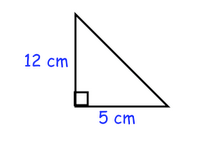
2. Answer the missing side.
one leg equals = 12 which is A side
the other = 5
so we go c=a+b
c2=12+5
c2= (12x12) + (5x5)
c2= 144+25
c2=169( sqaure root it )
c=13
so the answer will be the c= 13 2
3.is the triangle a right triangle? prove it !!!
a or b = 8
the other side (a or b) = 6
a2+b2=c2
8+6=14
14(2)=11(2)
the triangle is not a right triangle
b2 - is also one of the legs
Showing posts with label pythagorean relationship. Show all posts
Showing posts with label pythagorean relationship. Show all posts
Tuesday, February 14, 2012

Steven's pythagorean relationship texbook questions (4,10,15)
4) Estimate the square root of each number, to one decimal. Check with a calculator.


a) 72 b) 103 c) 55

10. Kai uses an entire can of paint on a square backdrop for the school play. The label on the can states that one can cover 27 m² of wall surface. Estimate the backdrop's side length, to one decimal place.
.
5x5=25 and 6x6=36 so it should be between the numbers 5 and 6.
5.2x5.2=27.04 then it move it up into one decimal place which is 5.3
15. Order the following numbers from least to greatest: 7, square root of 46, 5.8, square root of 27, and 6.3.
5.1, 5.8, 6.3, 6.7, 7
1) Answer in a short paragraph with diagrams
1) Answer in a short paragraph with diagrams


pythagorean relationship
1. Answer in a short paragraph and with diagrams

a² and b² are equal to form the hypotenuse.
2. Solve for the missing side length.

13cm
3. Is this a right triangle? Prove it!!!


a² and b² are equal to form the hypotenuse.
2. Solve for the missing side length.

13cm
3. Is this a right triangle? Prove it!!!

Jay's Pythagorean Relationship
1. Answer in a short paragraph and with diagrams
2. Solve for the missing side length.
13cm
3. Is this a right triangle? Prove it!!!
Both a2 and b2 are equal to find the side length of the hypotenuse.
13cm
No. Both legs are not equal to hypotenuse.
Monday, February 13, 2012
Liyanah's Pythagorean Post
1. Answer in a short paragraph and with diagrams

a² + b² = c²:
The Pythagorean Relationship means that the two legs (a & b) both equal to the hypotenuse. So for example we had the two legs (a &b) which are 3 and 4, and the hypotenuse is 5. Now you use the Pythagorean Relationship which is a² + b² = c² and put the numbers in now so this is how the steps would go:
a² + b² = c²
3² + 4² = 5²
(3x3) + (4x4) = (5x5)
9cm + 16cm = 25cm
25 = 25 - therefore, it is a right triangle
Here is a picture of what the triangle looks like:

2. Solve for the missing side length.

My answer:

3. Is this a right triangle? Prove it!!!

My answer:


a² + b² = c²:
The Pythagorean Relationship means that the two legs (a & b) both equal to the hypotenuse. So for example we had the two legs (a &b) which are 3 and 4, and the hypotenuse is 5. Now you use the Pythagorean Relationship which is a² + b² = c² and put the numbers in now so this is how the steps would go:
a² + b² = c²
3² + 4² = 5²
(3x3) + (4x4) = (5x5)
9cm + 16cm = 25cm
25 = 25 - therefore, it is a right triangle
Here is a picture of what the triangle looks like:


My answer:

3. Is this a right triangle? Prove it!!!

My answer:

Charisse's Pythagorean Relationship
1. Answer in a short paragraph and with diagrams
a(squared) + b(squared) = C(squared)
This Pythagorean Relationship means that the legs of the right triangle together equals to the hypotenuse, which is the longest side length of the right triangle. Say if the side lengths of the right triangle (A and B) were 4 and 3 and the hypotenuse (C) was 5. You would sub the letters to numbers.. so it would be 4(squared) + 3(squared) = 5(squared). Squared means to times it's number by it self, so it would be 4x4+3x3=5x5. So now you multiply the numbers, 4x4=16, 3x3=9, 5x5=25. 16+9=25, Both of the legs together equals to the hypotenuse, therefore it is a right triangle.
2. Solve for the missing side length.

3. Is this a right triangle? Prove it!!!

Pythagorean Relationship
1. Explain what the pythagorean relationship.
a2+b2=c2
a2+b2 = c2 because the 2 legs are smaller than the hypotenuse and for it to equal c2, you have to square a2 and b2 and square root it after to get the hypotenuse(c2).
2.c2=a2+b2
c2=122+5cm2
c2=(12x12)+(5x5)
c2=144+25
c2=169cm2
square root 169= 13cm
3.Is this a right triangle?
a2+b2=c2
82+62=112
(8x8)+(6x6)=(11x11)
64+36 does not equal 121
So It is not a right triangle.
a2+b2=c2
a2+b2 = c2 because the 2 legs are smaller than the hypotenuse and for it to equal c2, you have to square a2 and b2 and square root it after to get the hypotenuse(c2).
2.c2=a2+b2
c2=122+5cm2
c2=(12x12)+(5x5)
c2=144+25
c2=169cm2
square root 169= 13cm
3.Is this a right triangle?
a2+b2=c2
82+62=112
(8x8)+(6x6)=(11x11)
64+36 does not equal 121
So It is not a right triangle.
Pythagorean Scribe/ Textbook pythagorean questions
1. Answer in a short paragraph and with diagrams
1. Explain what the pythagorean relationship.
a2+b2=c2
a2+b2 = c2 because the 2 legs are smaller than the hypotenuse and for it to equal c2, you have to square a2 and b2 and square root it after to get the hypotenuse(c2).
1. Explain what the pythagorean relationship.
a2+b2=c2
a2+b2 = c2 because the 2 legs are smaller than the hypotenuse and for it to equal c2, you have to square a2 and b2 and square root it after to get the hypotenuse(c2).
2. Solve for the missing side length.
a= 5cm b= 12cm c=?
c2=a2+b2
c2=5cm2+ 12cm2
c2=(5x5)+(12x12)
c2=25+144
c2= 169cm2
c=13cm
a= 5cm b= 12cm c=?
c2=a2+b2
c2=5cm2+ 12cm2
c2=(5x5)+(12x12)
c2=25+144
c2= 169cm2
c=13cm
3. Is this a right triangle? Prove it!
a=6cm b=8cm c=11cm
a2+b2=c2
6cm2+8cm2= 11cm2
(6x6)+(8x8)=(11x11)
36+64=121
36+64=100
c=10
It is not a right triangle because it doesn't equal the hypotenuse.
Textbook Questions pg. 92-93 # 5,9,13
36+64=100
c=10
It is not a right triangle because it doesn't equal the hypotenuse.
Textbook Questions pg. 92-93 # 5,9,13
5.A right triangle has side lengths of 40mm, 75mm, and 85mm.
a)Sketch the triangle. Draw a square on each side of the triangle.

b)What are the areas of the three squares.
b)40mm= 40x40= 1,600
75x75= 5,625
85x85= 7,225
c)Write an addition statement with the areas of the three squares.
c) 1600+5625+7226= 14,451 mm
9.Calculate the areas of the three squares
4cm= 4x4=16cm
2x2= 4cm
3x3= 9cm

b) Is this triangle a right triangle? Explain.
b) No because 2+3 cm squared has to equal 4cm squared but it does not. 9+4 does not equal 16.
13. A small triangular flower bed has a square stepping stone at each of its sides. Is the flower bed in the shape of a right triangle? Explain your reasoning.

It is not a right triangle because the 2 legs (4800cm) has to equal the hypotenuse (9800cm) if u add them up. 4800+4800=9600 cm
not 9800cm.
Kamille's Pythagorean Post
1. Answer in a short paragraph and with diagrams

YES!
You can use the Pythagorean relationship to know if a triangle is right triangle or not. The "a" and "b" on a right triangle represents the legs. The "c" is called the hypotenuse. If you add both side lengths of a and b you will get the hypotenuse. You can also determine a missing side length using one of this formulas
a²= c² - b²
b²= c² - a²
c²= a² +b²
2. Solve for the missing side length.
c²= a² +b²
c²= 12cm+5cm
c²= (12x12)+(5x5)
c²= 144cm²+25cm²
c²= 169cm²
√ c² = 169cm²
√ c = 13cm
3. Is this a right triangle? Prove it!!!
YES!
c²= a² +b²
c²= 8cm+6cm
c²= (8x8)+(6x6)
c²= 64cm²+36cm²
c²= 100cm²
√ c² = 100cm²
√ c = 10cm
Elijah's Pythagorean Post
1. Answer in a short paragraph and with diagrams
The Pythagorean Relationship is a right triangle that consists of a hypotenuse and two legs. The hypotenuse is ALWAYS larger than the two legs but when the two legs are summed up it equals the hypotenuse.

2. Solve for the missing side length
 a squared + b squared= c squared
12cm squared + 5cm squared= c squared
(12x12) + (5x5)= c squared
144 + 25= 169cm squared
c squared= 169 squared
c=14cm
3. Is this a right triangle? Prove it!!
 a squared + b squared= c squared
8cm squared + 6cm squared= 11cm squared
(8x8) + (6x6)= 11cm squared
64cm squared + 36cm squared= 11cm squared
c squared= 100 squared cm
c= 10cm
No it is not a right triangle
Oudorn's Textbook Questions (12,14,17)
12. While shopping online, Ji Hun finds a square rug with the area of 11 m squared. He needs to know if it will fit his 4m x 5m bedroom.
a)Estimate the side length of the rug, to one decimal place

b)Check your estimate with a calculator.
Square root of 11=3.316
c) Will the rug fit? Explain.
Yes it will, because the area of the room is 20m²
14. Alex is thinking of a number. The number has a square root between 7 and 8, and a multiple of 12.
a) What number could he be thinking of?
60
b) Is there more than one answer? Explain.
No, because 60 is the only number that is between the square root of 7 and 8 that is a multiple of 12.
17. Carmel wants to mount an 18cm x 18cm square picture on a square board that is four times the area or the picture
a) What is the area of the picture?

Area = 324cm²
b) What is the area of the board?
b) What is the area of the board?
324 x 324 = 1296cm²
c) What are the dimensions of the board?
Square root of 1296= 36cm
Square root of 1296= 36cm
36 x 36 = 1296cm²
Pythagorean Relationship
1.Answer in short paragraph and with diagrams
a² + b² = c² is a formula. If you take the legs of the triangle( a and b), square them, then add them, you will get c²(hypotenuse²). You can determain if the triangle is a right triangle or not by doing a² + b² = c².
2. Solve for the missing side length.

C²= A²(5cm)+B²(12cm)
C²=5²+12²C²=(5x5)+(12x12)
C²=25+144
C²=169
C= square root of 169
C= 13cm
3.Is this a right triangle? Prove it!!!

Diana's Pythagorean Relationship
1. Answer in a short paragraph and with diagrams

For this first question, I'm going to be writing about Pythagorean Relationship and show a diagram. A Pythagorean relationship can be used to determine whether a triangle is a right triangle or not. The "a²" and "b²" are called the "legs". The "c" stands for " hypotenuse". To find the side length "a" you use a²= c² - b²; for b, you use b²= c² - a² and for "c" you use c²= a² + b². These are some facts that I know about Pythagorean Relationship.
2. Solve for the missing side length.

3. Is this a right triangle? Prove it!!!

Patricia's Pythagorean Post
1. Answer in a short paragraph and with diagrams
The relationship between the lengths of the side of the right triangle. The sum of the areas of the squares attached to the legs of a right triangle equals the area of a square attached to the hypotenuse.

the Pythagorean relationship can be used to show if a triangle is a right triangle. Left side: 7 squared+6 square= 13 squared (7x7)+(6x6)=(13x13) 49+36=85 square root of "C" squared= square root of 100cm squared is 10
C=10cmthe sum of the areas of the two smaller squares is 100cm squared. the triangle is a right triangle.

a squared+b squared= c squared 8 squared+6 squared=11 squared (8x8)+(6x6)=(11x11) 64+36=121 square root of "C"squared= square root of 121cm squared is 11
C=11cm
the triangle a right triangle.
3. Is this a right triangle? Prove it!!!

a squared + b squared = c squared
8 squared + 6 squared = 11 squared
(8x8) + (6x6) = (11x11)
64 + 36 = 121
It's not a right triangle because it's not equal. The legs aren't equal to the hypotenuse.
The relationship between the lengths of the side of the right triangle. The sum of the areas of the squares attached to the legs of a right triangle equals the area of a square attached to the hypotenuse.
the Pythagorean relationship can be used to show if a triangle is a right triangle. Left side: 7 squared+6 square= 13 squared (7x7)+(6x6)=(13x13) 49+36=85 square root of "C" squared= square root of 100cm squared is 10
C=10cmthe sum of the areas of the two smaller squares is 100cm squared. the triangle is a right triangle.
2.Solve the missing side length
a squared+b squared= c squared 8 squared+6 squared=11 squared (8x8)+(6x6)=(11x11) 64+36=121 square root of "C"squared= square root of 121cm squared is 11
C=11cm
the triangle a right triangle.
3. Is this a right triangle? Prove it!!!

a squared + b squared = c squared
8 squared + 6 squared = 11 squared
(8x8) + (6x6) = (11x11)
64 + 36 = 121
It's not a right triangle because it's not equal. The legs aren't equal to the hypotenuse.
Textbook Questions
5.a) What is the area of each square attached?
a squared = 6 squared
a squared = 6 x 6
b squared = 8
squared
b squared = 8 x
8
b squared
= 64 cm squared
b) c squared = a squared + b
squared
c squared = 36 + 64
c squared = 100 cm squared
c) square root "c" squared and then square root 100 cm
squared
c = 10 cm
19. estimate the square root of 160 100
square root of 100 =40
square root of 160=10
10x40=400
14.
Alex is thinking of a number. The number has a square root between 7 and 8, and
a multiple of 12.
a) What number could he be thinking of?60
b) Is there more than one answer?
Explain.
No, because 60 is the only number that is between the square root of
7 and 8 that is a multiple of 12.
Sunday, February 12, 2012
Pythagorean Relationship Scribe
1. Pythagorean relationship is the sum of the square attached to the legs is equal to the square attached to the hypotenuse. It's also the formula to find the missing side and determine wether it's a right triangle or not.

2. Solve for the missing side length.

3. Is this a right triangle? Prove it!!!

2. Solve for the missing side length.

3. Is this a right triangle? Prove it!!!


Sunday, February 5, 2012
Pythagorean Relationship Scribe Post
1. Answer in a short paragraph and with diagrams
.

.

The Pythagorean relationship is the sum of the two legs of a right triangle which are equal to the hypotenuse. It's also a formula that find the missing value of a side and if the right triangle is actually a right triangle or not.
2. Solve for the missing side length.
2. Solve for the missing side length.
.3. Is this a right triangle? Prove it!!!
.
Subscribe to:
Posts (Atom)